Introduction
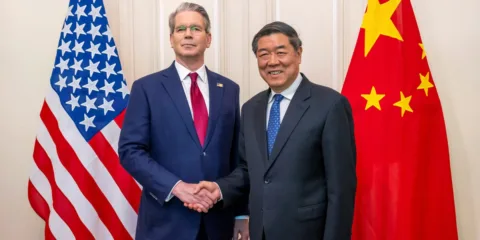
High-stakes trade negotiations between the United States and China are once again taking center stage. Three senior Trump administration officials—Secretary of the Treasury Scott Bessent, Secretary of Commerce Howard Lutnick, and Trade Representative Jamieson Greer—will meet with Chinese representatives in London on Monday in a bid to ease trade tensions and find common ground. This marks the first official dialogue since the two economic giants agreed to a temporary tariff truce on May 12.
Key Players in the Renewed Negotiations
While President Trump expressed optimism about the meeting via his social media platform, the Chinese side has yet to officially confirm their delegates. However, past participation offers a strong hint. China’s Geneva delegation included Vice Premier He Lifeng, Vice Commerce Minister Li Chenggang—who holds a Master of Laws from the University of Hamburg—and Vice Finance Minister Liao Min.
Their collective expertise, especially Li’s involvement in the World Trade Organization since 2021, adds a layer of complexity and depth to these discussions.
Backdrop to the Talks: The Temporary Tariff Truce
The current round of negotiations follows a 90-minute direct call between Trump and Chinese President Xi Jinping—an unusual gesture suggesting urgency on both sides. On May 12, both nations agreed to a 90-day suspension of tariffs, offering a short window for meaningful progress.
However, time is running out. If no deal is struck by August 12, the tariff pause will expire, potentially reigniting tensions and market instability.
Strategic Implications for Business and Global Trade
The stakes are high not only for governments but also for global businesses. Tariffs imposed under the Trump administration have already increased operational costs for American firms. According to Philip Luck, Director of the CSIS Economics Program, “These policies have been costly for Americans and American companies, and therefore, the market doesn’t like it.”
For entrepreneurs, marketers, and supply chain strategists, understanding these dynamics is critical. Whether you’re sourcing products internationally or navigating fluctuating trade policies, staying informed allows you to pivot strategically.
Legal Uncertainty and the Looming Lawsuit
Adding another layer of uncertainty is a pending lawsuit that could invalidate tariffs enacted under the International Emergency Economic Powers Act (IEEPA). According to Drew DeLong, geopolitical dynamics lead at Kearney, if the court strikes them down before a deal is reached, alternative avenues for imposing tariffs could prove more complicated and time-consuming.
Such legal risks compound the urgency for both sides to solidify agreements before the truce deadline.
Trenzest Insight: Why Entrepreneurs Should Pay Attention
At Trenzest, we continuously monitor geopolitical shifts like these to help entrepreneurs and small business owners navigate a rapidly changing economic landscape. Whether you’re focused on eCommerce, international marketing, or supply chain optimization, understanding trade policy implications is essential.
Conclusion: The Road Ahead for US-China Relations
As the London negotiations unfold, the world will be watching closely. The outcomes could influence everything from international investment flows to consumer pricing across industries. While optimism prevails in public messaging, the underlying complexities—from legal hurdles to policy pressures—make this a defining moment in US-China relations.
For forward-thinking professionals, staying ahead of these shifts is not just smart—it’s essential. Visit Trenzest to explore our latest insights, tools, and resources that empower you to thrive amid uncertainty.