
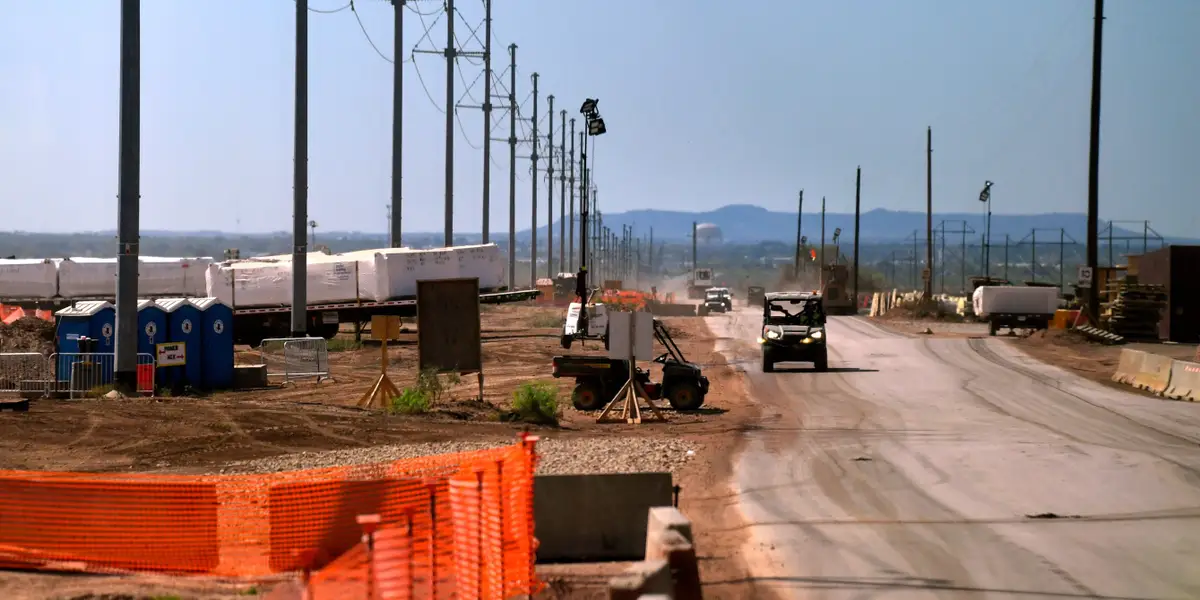
Oracle and OpenAI are taking their next big artificial intelligence venture—Project Stargate—off the grid. The two companies are collaborating on a new AI data center in Shackelford County, Texas, which will run on hundreds of natural gas generators, completely bypassing the strained U.S. power grid. This bold move shows just how rapidly the AI boom is transforming both technology and the energy industry.
AI’s Growing Power Hunger
The rise of artificial intelligence has created an unprecedented demand for electricity. Data centers that train and host AI models like ChatGPT require immense amounts of power, often measured in gigawatts. Traditional grid systems in the United States, already under strain, can take years to accommodate such large new energy demands.
That’s why major tech firms are now turning to “off-grid” or “behind-the-meter” energy solutions—systems where they produce their own power instead of waiting to connect to public utilities. These private energy networks, also known as microgrids, allow data centers to go live faster while maintaining consistent, scalable power.
The Shackelford County Microgrid
The upcoming Stargate site in Shackelford County is the latest example of this trend. According to a confidential “Oracle Fact Sheet” dated September 23, 2025—shared during a private event for state and local officials—the facility will operate with an onsite, gas-powered microgrid. This setup enables it to generate its own electricity independently of local utilities, cutting through grid bottlenecks and accelerating construction timelines.
The document, which surfaced through U.S. Representative Jodey Arrington’s office, reveals that Oracle, Vantage Data Centers, and Voltagrid are development partners for the project. Both Vantage and Voltagrid have confirmed their roles.
Powering AI With Natural Gas
Public records from the Texas Commission on Environmental Quality (TCEQ) show that Voltagrid has received approval to install 210 industrial natural gas generators near the Shackelford site. These generators, produced by the Austrian company Jenbacher, will deliver up to 700 megawatts of power in the first construction phase. Nearly all of the engines will be used as the facility’s primary power source, while 13 will serve as emergency backups.
Voltagrid says the completed microgrid will ultimately support 1.4 gigawatts of compute capacity—enough to power one of the largest AI data centers in the world. To put that into perspective, OpenAI CEO Sam Altman has stated that he envisions Project Stargate scaling beyond 10 gigawatts across multiple sites.
A Rapidly Expanding AI Hub
The Shackelford site is located roughly 40 minutes from the first Stargate data center in Abilene, Texas, which already uses a smaller fleet of natural gas generators for backup power. Together, these facilities form part of a growing AI infrastructure corridor in West Texas—an area rich in energy resources and land availability.
Vantage Data Centers has branded the Shackelford project as “Frontier”, describing it as a mega-campus comprising 10 massive data center buildings spread across 3.7 million square feet. The first phase of construction could go live as early as 2026, depending on permitting and energy installation timelines.
Why Off-Grid Data Centers Are the Future
The decision by Oracle and OpenAI to build a self-powered AI data center reflects a broader industry shift. As AI applications—from generative models to large-scale cloud services—consume more electricity, the traditional power grid can’t keep up. According to the Lawrence Berkeley National Laboratory, some new data centers face multi-year delays before they can even connect to the grid.
By generating their own energy through natural gas microgrids, companies can deploy AI infrastructure faster and more reliably. While natural gas is still a fossil fuel, its use allows for immediate scalability while renewable energy technologies continue to mature. Many analysts expect future AI data centers to blend gas with solar, wind, or even nuclear power sources for sustainable long-term growth.
A Glimpse Into the AI Energy Revolution
Oracle and OpenAI’s off-grid strategy highlights how the AI revolution is now driving an energy revolution. Massive computational demand is reshaping not only the tech landscape but also how energy is produced, distributed, and consumed in the U.S.
As Project Stargate expands, it’s likely to inspire similar developments across the country—AI megacenters powered by their own microgrids, optimized for both performance and speed. With Texas becoming ground zero for this new wave of infrastructure, the line between energy company and technology company is rapidly disappearing.
For more articles like this visit Trenzest.