Introduction
The automotive world is accelerating toward a future where artificial intelligence (AI) is central to safe, efficient driving. In a landmark move, Nissan has announced that it will integrate Wayve’s self-driving software into its advanced driver assistance systems (ADAS) by 2027. This collaboration marks a significant milestone not just for Nissan, but for the broader auto tech landscape, especially as Wayve continues to attract attention from major investors like Nvidia, Microsoft, SoftBank Group, and Uber, securing over $1.3 billion in funding.
This partnership signals a shift toward more adaptable, data-driven solutions that could redefine how automakers approach semi-autonomous driving technologies.

Wayve’s Breakthrough: Self-Learning Autonomous Driving
Founded in 2017, Wayve has quickly established itself as a pioneer in automated driving, distinguishing its technology from traditional systems with a self-learning approach. Unlike rule-based models, Wayve’s end-to-end learning system is designed to evolve through real-world experience—similar to Tesla’s methodology but with its own unique angle.
Wayve’s Embodied AI technology is built to learn dynamically, offering both “eyes on” (driver-assisted) and “eyes off” (fully autonomous) capabilities. This flexibility makes it particularly attractive to automakers seeking scalable and efficient solutions for a wide range of vehicles and conditions.
Nissan’s Vision: Elevating ProPilot with Embodied AI
Nissan plans to enhance its existing ProPilot system by incorporating Wayve’s software alongside additional sensors, including lidar technology from an undisclosed supplier. According to Nissan, this next-generation system will establish a “new standard for autonomous driving,” particularly emphasizing advanced collision avoidance.
Importantly, the system will be developed for mass production with an expected launch in 2027. Although Nissan has not yet disclosed which models will feature this technology, the update demonstrates the company’s commitment to maintaining a competitive edge in intelligent vehicle technologies.
Shiro Nagai, a spokesperson for Nissan, emphasized that leveraging Wayve’s Embodied AI will allow future Nissan models to mirror the judgment and actions of careful, competent human drivers even in complex environments—a bold promise in an increasingly crowded space.
Understanding Level 2 Autonomy
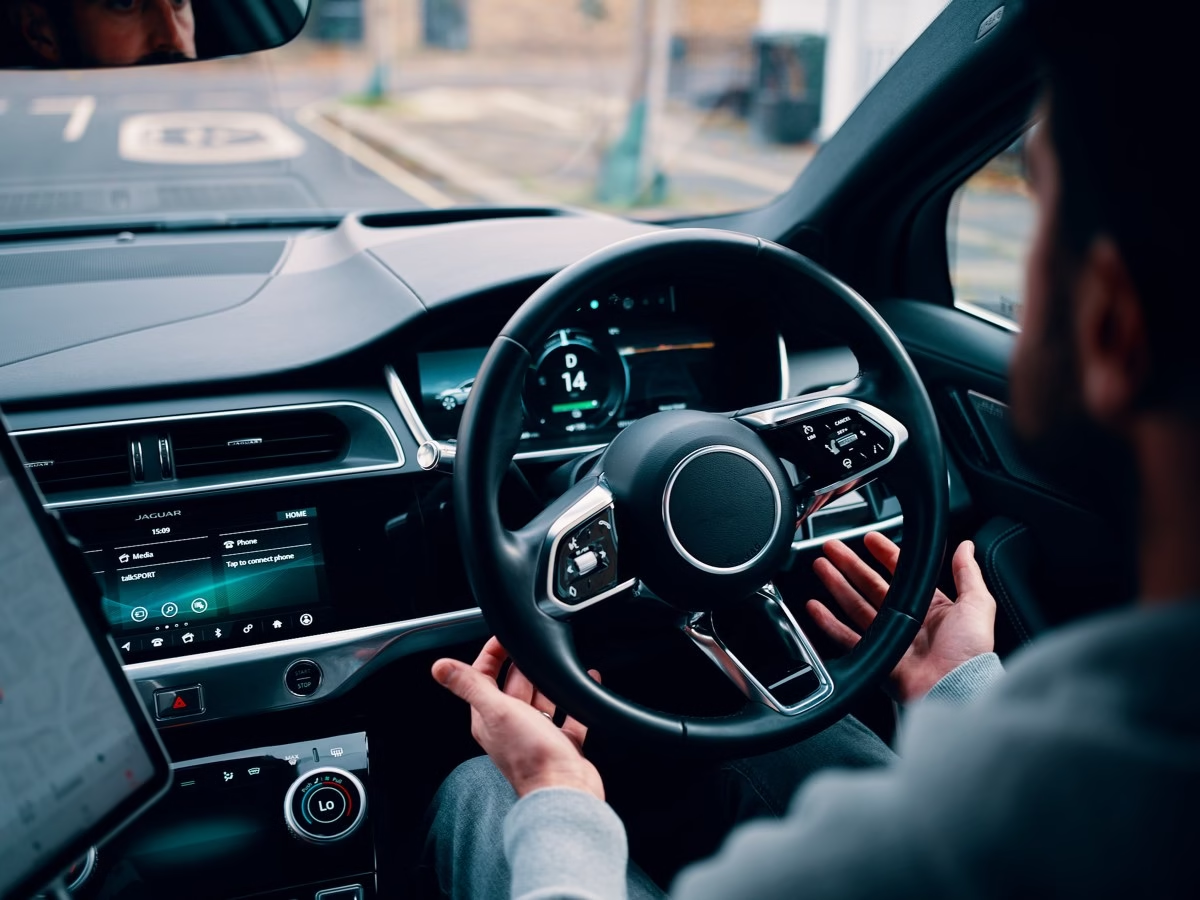
The upcoming system will be classified as Level 2 autonomy, based on the standards set by the Society of Automotive Engineers (SAE). In a Level 2 system:
The vehicle can manage multiple driving functions like steering, accelerating, and braking.
Driver supervision is mandatory at all times.
This level strikes a balance between innovation and practicality, allowing consumers to experience some benefits of automation without relinquishing full control, an important consideration for consumer trust and regulatory approval.
Wayve’s Edge Over Traditional Systems
A key differentiator for Wayve is that its system isn’t heavily dependent on specific sensor setups or high-definition (HD) maps, unlike many existing autonomous driving platforms. Instead, it flexibly adapts to:
Standard cameras
Radar systems
Various sensor configurations
This versatility reduces the cost of implementation and maintenance—an attractive proposition for automakers aiming to integrate autonomous features across multiple models without redesigning their vehicles from the ground up.
Moreover, Wayve’s software is designed to be hardware-agnostic. While its development fleet utilizes Nvidia’s Orin system-on-chip, CEO Alex Kendall has stated that their AI can operate on any GPU platform currently deployed by automakers.
The Strategic Advantage for Nissan and Beyond
By partnering with Wayve, Nissan stands to not only modernize its fleet but also lower operational costs, minimize reliance on specialized infrastructure, and accelerate time-to-market for advanced driving features.
Wayve’s software isn’t just limited to passenger vehicles. It is versatile enough for robotaxis and even robotics applications, hinting at broader commercial possibilities beyond personal transportation.
External market forces, such as increased investments in autonomous mobility and tightening safety regulations, make this partnership timely and strategic. As competition intensifies among automakers and tech companies, early movers like Nissan could capture significant market share in a fast-evolving space.
Conclusion: Driving Toward a Smarter Future
Nissan’s collaboration with Wayve is more than a technological upgrade—it’s a strategic alignment with the future of driving. By leveraging self-learning AI and flexible hardware integration, Nissan is setting the stage for a smarter, safer, and more adaptive driving experience by 2027.
As the automotive world races toward increased automation, partnerships like this exemplify how innovation, agility, and vision can turn ambitious concepts into road-ready realities.
Stay connected with Trenzest to navigate the next wave of AI-powered transformation and drive your business or career forward.