
Introduction: Rethinking Brain Evolution
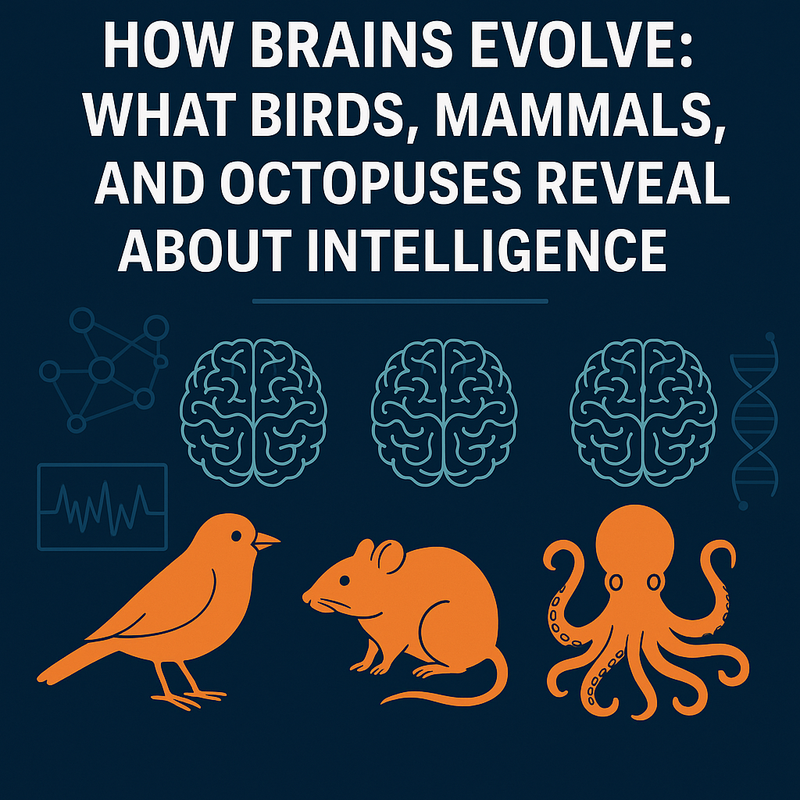
What defines intelligence? Is there a blueprint nature follows, or do different lifeforms find their own path to complex cognition? Recent studies on birds, mammals, and octopuses are reshaping our understanding of how brains evolve—and more importantly, what this evolution means for artificial intelligence (AI), neuroscience, and innovation.
Flexible Circuitry: A New Look at Bird Brains
In a groundbreaking study, neuroscientist Zaremba and her team discovered that birds can develop similar neural circuits using different types of cells. “You can build the same circuits from different cell types,” she explained, challenging long-held assumptions about neural development in vertebrates.
Their findings suggest that bird brains don’t strictly follow the mammalian model. Instead, they reorganize significantly during development, which means neurons originating from different regions in the embryonic brain can mature into similar adult neuron types. This flexibility opens up new possibilities in understanding how cognitive functions evolve independently.
Challenging Traditional Models of Brain Development
In mammals, the development of the brain follows a more predictable path—cells from the embryonic amygdala become part of the adult amygdala, and the cortex cells become cortex neurons. Birds, however, defy this template.
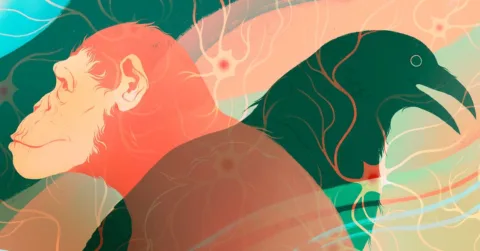
According to Onur Güntürkün, a neuroscientist involved in the study, “There is a fantastic reorganization of the forebrain in birds, nothing that we had expected.” This suggests that complex cognition evolved differently in birds and mammals, a finding that strengthens the theory of convergent evolution.
Convergent Evolution: Intelligence Finds a Way
Convergent evolution refers to the process where unrelated species evolve similar traits independently. Intelligence appears to be one such trait.
Maria Tosches of Columbia University emphasizes that “there’s limited degrees of freedom into which you can generate an intelligent brain, at least within vertebrates.” In other words, evolution has a finite number of ways to build a brain capable of problem-solving, reasoning, and adaptability.
Examples of convergent evolution abound: birds and bats developed flight separately, while mammals and cephalopods like octopuses evolved complex nervous systems in isolation from each other.
Octopuses: Alien Intelligence on Earth
Octopuses represent one of the most fascinating cases of independently evolved intelligence. Despite having radically different brain structures, these cephalopods exhibit advanced problem-solving skills—escaping enclosures, solving puzzles, and using tools.
Their neurons are organized in a decentralized network, with many located in their arms. This shows that intelligence can arise even in structures that seem alien compared to the vertebrate brain, proving that there’s no single “right” way to think.
Common Genetic Threads in Brain Development
Although evolution carved different paths, research using deep learning techniques revealed shared genetic blueprints between species. Mice, chickens, and humans all share stretches of DNA that influence the development of the neocortex or DVR (dorsal ventricular ridge).
This overlap suggests that while brain architectures may diverge, the genetic “tools” used for building cognitive regions are somewhat conserved. Furthermore, inhibitory neurons—responsible for modulating brain activity—appear across both bird and mammalian species, adding another layer of similarity.
Debating the Origins: Karten vs. Puelles
This new research reignites an ongoing debate in neuroscience between two schools of thought. While Tosches aligns more with Puelles, Güntürkün sees the findings supporting Karten’s theories. Others, like García-Moreno, suggest a middle ground: “Both of them were right; none of them was wrong.”
These contrasting views demonstrate how evolving data continues to refine our understanding of brain development and cognition.
Implications for Artificial Intelligence
What do bird brains and octopus arms have to do with AI? A lot, actually.
Zaremba suggests that understanding how intelligence evolves independently could inform how we design future AI systems. Currently, AI development tends to be anthropocentric—modeled after human thinking. But what if we explored how a bird or an octopus “thinks”?
Researcher Kempynck speculates, “Can we build artificial intelligence from a bird perspective? How does a bird think? Can we mimic that?”
This non-human-centric approach could revolutionize machine learning and cognitive computing by revealing new, efficient ways of solving problems.
Conclusion: Rethinking Intelligence Across Species
The evolution of intelligence isn’t a straight line—it’s a branching network of innovations, reconfigurations, and convergences. From the forebrains of birds to the tentacles of octopuses, nature has repeatedly shown us that intelligence can emerge in unexpected ways.
These insights challenge us to think differently—not just about animals, but about how we build artificial systems and solve complex problems. As science continues to decode the architecture of the mind, the potential to reshape AI and cognitive science grows exponentially.