Introduction
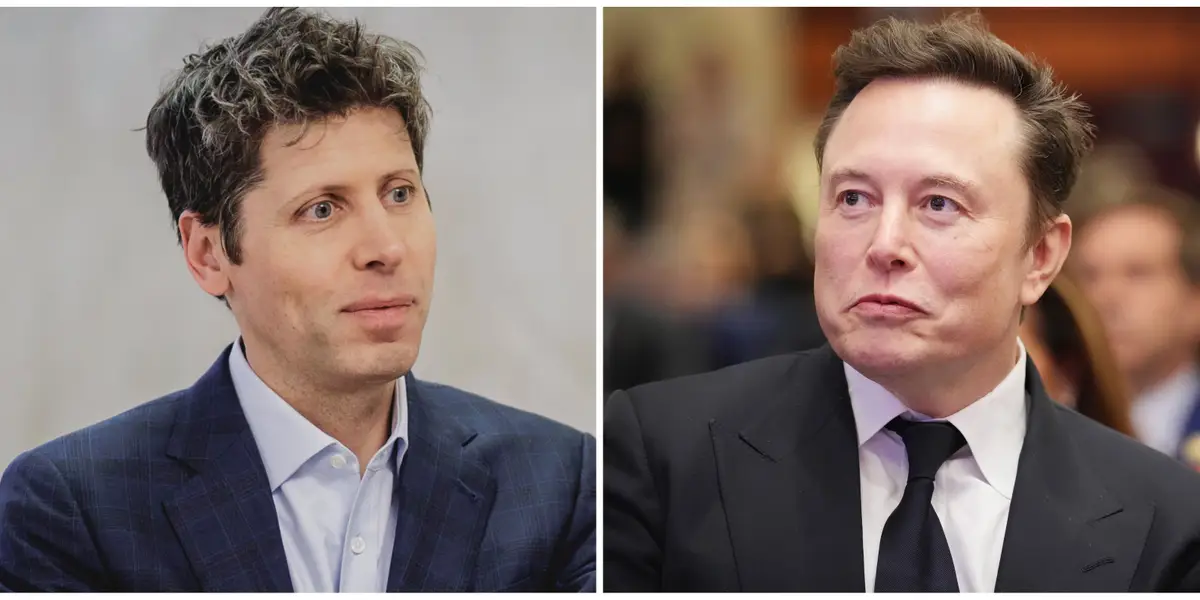
The long-running feud between Elon Musk and Sam Altman—two of Silicon Valley’s most influential tech leaders—flared up once again this weekend. The dispute, rooted in the transformation of OpenAI, escalated into a public back-and-forth on X (formerly Twitter), revealing lingering resentment over the direction of the company they once cofounded together.
A War of Words on X
The latest exchange began on Saturday when Musk accused Altman of having “stolen a non-profit.” His comment was a direct response to an X post by Altman discussing a separate issue involving a Tesla order cancellation.
Musk’s post reignited tensions that have simmered since his 2018 departure from OpenAI’s board. In reply, Altman fired back, saying:
“I helped turn the thing you left for dead into what should be the largest non-profit ever.”
He went on to explain that OpenAI’s current hybrid structure—a nonprofit foundation with a for-profit subsidiary—was necessary for the scale of its ambitions.
“You know as well as anyone a structure like what OpenAI has now is required to make that happen,” Altman added.
He then accused Musk of wanting Tesla to absorb OpenAI entirely, abandoning its nonprofit mission.
“You also wanted Tesla to take OpenAI over, no nonprofit at all. And you said we had a 0% chance of success. Now you have a great AI company and so do we.”
Altman ended his string of posts on a conciliatory note, writing, “Can’t we all just move on?”
From Co-Founders to Competitors
OpenAI was founded in 2015 by Elon Musk, Sam Altman, Greg Brockman, and Ilya Sutskever as a nonprofit research lab dedicated to developing safe artificial intelligence. The company aimed to counterbalance the growing dominance of AI research within tech giants like Google.
However, Musk stepped down from the board in 2018, citing potential conflicts of interest with Tesla’s own AI initiatives. After his exit, OpenAI underwent major structural changes to attract the capital needed to train increasingly large AI models.
Meanwhile, Musk launched xAI in 2023, a direct competitor to OpenAI, further widening the rift between the two tech leaders.
The Spark Behind the Latest Clash
The current social media scuffle didn’t start with AI. It was triggered by an entirely different issue: a Tesla Roadster reservation dispute.
Altman posted screenshots showing a $45,000 deposit made in July 2018 for a next-generation Tesla Roadster. He later requested a $50,000 refund, only for the email to bounce back. The post quickly caught the attention of Musk, who seized the opportunity to accuse Altman of betraying OpenAI’s founding mission.
Representatives for both Musk and Altman declined to comment when contacted by Business Insider.
OpenAI’s Meteoric Rise
Since Musk’s departure, OpenAI has grown from a small nonprofit lab into one of the most powerful players in artificial intelligence. The release of ChatGPT in 2022, a generative chatbot powered by large language models, propelled OpenAI to global fame.
Today, OpenAI’s technology powers millions of applications and partnerships across industries. But its shift toward a for-profit model has sparked debate over whether it still aligns with its original open-source, nonprofit principles.
Musk’s Criticism and Legal Battles
Musk has repeatedly voiced his frustration over OpenAI’s evolution. In a 2023 X post, he wrote:
“OpenAI was created as an open source, non-profit company to serve as a counterweight to Google, but now it has become a closed source, maximum-profit company effectively controlled by Microsoft. Not what I intended at all.”
In early 2024, Musk filed a lawsuit against OpenAI and Altman, alleging that they had “deceived” him into cofounding the organization by appealing to his concerns about AI safety. The legal filings sought to block OpenAI’s transition from nonprofit to for-profit, arguing it violated the company’s founding agreement.
OpenAI’s Response and New Structure
In October 2025, OpenAI officially completed its restructuring. The company’s nonprofit division, now known as the OpenAI Foundation, retains control of the for-profit arm, called OpenAI Group PBC.
According to OpenAI’s blog, the foundation currently holds equity valued at approximately $130 billion, making it one of the world’s most well-funded philanthropic organizations. The foundation also gains additional ownership as OpenAI’s valuation increases.
“The OpenAI Foundation and OpenAI Group will work in concert to advance solutions to the challenges and opportunities posed by AI progress,” the company stated.
Conclusion
The feud between Elon Musk and Sam Altman reflects deeper ideological tensions within the tech industry—between the open-source ideals of AI research and the financial realities of scaling such technology.
While Musk and Altman continue to trade jabs online, both men now helm influential AI companies that are shaping the future of artificial intelligence. Whether their rivalry will cool down—or escalate further—remains to be seen.
For more articles like this visit Trenzest.