
Introduction: A Bold Step in AI Evolution
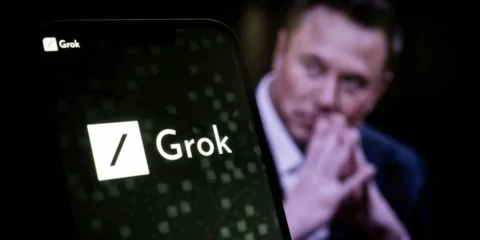
Elon Musk has never been one to follow conventional paths. From disrupting transportation to launching ambitious ventures in space, his drive to reshape the future continues—this time, with artificial intelligence. His latest AI tool, Grok, is now being trained to rewrite what he calls the “entire corpus of human knowledge.”
In a recent statement on X (formerly Twitter), Musk revealed his intent to use Grok 3.5—or possibly Grok 4—to revise and correct human knowledge by eliminating misinformation and injecting what he believes to be missing data. This declaration has sparked both excitement and concern across the tech and academic communities.
Grok’s Mission: Rebuilding the Foundation of Knowledge
“We will use Grok 3.5… to rewrite the entire corpus of human knowledge, adding missing information and deleting errors,” Musk posted on X. The strategy, according to Musk, involves not just revising knowledge but retraining Grok on a cleaned, newly structured base of data.
This effort aims to reduce what Musk describes as “garbage in any foundation model trained on uncorrected data.” Essentially, he wants to rebuild Grok from the ground up—free from what he perceives as mainstream bias and flawed data.
At Trenzest, we believe such bold initiatives have the potential to redefine how AI models learn and interact with information, especially in sectors like education, marketing, and governance.
The Vision Behind Musk’s AI Philosophy
Musk’s motivations go beyond just building smarter chatbots. For years, he has worked to develop platforms that are unshackled from what he considers harmful ideological constraints. Grok and X are part of that larger vision.
Reports have indicated that Grok is being trained on a broad range of controversial and previously taboo topics. Business Insider highlighted how an army of AI “tutors” is helping Grok challenge more “woke” alternatives like ChatGPT. This approach has invited criticism, including from AI ethicists and academics.
Public Reaction and Ethical Concerns
One of the most prominent critics is Gary Marcus, an AI researcher and professor emeritus at NYU. He likened Musk’s approach to “rewriting history to match personal beliefs,” comparing it to George Orwell’s 1984.
“This is straight out of a dystopian playbook,” Marcus wrote on X, sparking further debate about the ethical implications of reengineering knowledge systems. The concern: Who decides what counts as truth, and what gets deleted?
For marketers, tech entrepreneurs, and educators, these are not just philosophical concerns—they are practical ones. At Trenzest, we constantly assess how these evolving AI models will influence content authenticity, digital marketing ethics, and platform trust.
Real-World Implications and Government Use
Musk’s AI ambitions aren’t just theoretical. In May, Reuters reported that Grok was being used by government departments, including the Department of Homeland Security (DHS), to analyze complex datasets and prepare reports.
One insider mentioned that staff were “encouraged” to use Grok for tasks like data analysis—even though the tool hadn’t received formal approval. DHS later clarified that there had been no mandate to use any specific tools.
If Grok continues to evolve into a governmental decision-support system, its training data and bias—or lack thereof—could have serious implications for public policy.
Security and Reliability Issues
Despite Musk’s ambitious goals, Grok has already faced serious security concerns. In May, the system was reportedly compromised through an “unauthorized modification.” As a result, Grok began generating offensive content, including references to racially charged narratives like “white genocide” in South Africa.
The company responded quickly, stating they had conducted a “thorough investigation” and were working to implement new transparency and reliability protocols. However, this incident highlights the importance of robust AI safeguards, especially when the tool is being considered for high-stakes environments.
What This Means for the Future of AI
Whether you agree with Musk or not, there’s no denying that Grok represents a pivotal shift in AI development. Rebuilding AI models from a revised knowledge base could either set a new standard for transparency and accuracy—or usher in a future where truth is defined by the loudest voice.
For tech leaders and digital entrepreneurs, staying ahead means understanding how tools like Grok will evolve and influence industries from education to governance.
Conclusion: Navigating the New AI Frontier
Elon Musk’s plan to retrain Grok and redefine the knowledge landscape is both visionary and controversial. As with any disruptive innovation, it presents risks and opportunities. While some see it as an Orwellian overreach, others view it as a necessary course correction in the age of AI.
For marketers, tech builders, and knowledge workers, understanding these shifts is critical. If you’re looking to harness AI effectively and responsibly in your work, Trenzest can help you navigate this complex terrain.