Introduction: A Mind Like No Other
Even without Neuralink, Elon Musk is often described as having a mind that functions like a high-performance computer. His ability to manage multiple groundbreaking companies simultaneously—Tesla, SpaceX, xAI, Neuralink, and The Boring Company—demonstrates not just ambition but an unparalleled capacity for problem-solving.
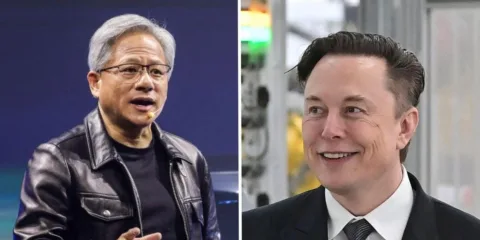
During a recent appearance on the BG2 Podcast, Nvidia CEO Jensen Huang compared Musk’s brain to one of Nvidia’s own GPUs, highlighting his ability to process vast amounts of complex information. According to Huang, Musk’s unique mental model allows him to coordinate finance, engineering, and infrastructure at a scale few can imagine.
The Complexity of AI Supercomputing
Building an AI supercomputer is no small feat. As Huang explained, these systems are “the most complex problem humanity has ever endeavored.” The challenges span across multiple domains:
Financing: Raising billions for hardware, data centers, and energy infrastructure.
Infrastructure: Securing land, power, and cooling capacity for massive GPU clusters.
Engineering: Designing interoperable systems that work seamlessly across multiple disciplines.
Each of these hurdles is difficult on its own, but Musk’s integrated vision allows him to tackle them as a single interconnected system.
Elon Musk’s Colossus II: A Gigawatt AI Training Cluster
Why Memphis? The Strategic Location
Musk’s Colossus II data center is currently under construction near Memphis, Tennessee. This location provides access to affordable energy, available land, and a central logistics hub—critical factors for building what he has described as “the world’s first gigawatt AI training cluster.”
The Scale: From 200,000 to 1 Million GPUs
Documents reviewed by Business Insider reveal that Musk has already invested at least $400 million into the project. Colossus II will initially feature 200,000 Nvidia GPUs but is designed to scale up to 1 million GPUs—a scale unmatched in today’s AI race.
This positions Musk’s xAI to compete not just with OpenAI (led by Sam Altman) but also with Big Tech giants like Google, Amazon, and Microsoft. Nvidia’s own projections show growing demand, with the company recently announcing a $100 billion investment into OpenAI data centers, illustrating the fierce competition in the AI infrastructure market (source).
Jensen Huang’s Perspective: Musk as the “Ultimate GPU”
On the podcast, Huang described Musk as possessing both urgency and capability:
“When will comes together with skill, unbelievable things can happen.”
The comparison to a “big GPT” or even the “ultimate GPU” underscores Musk’s role as a central node in this rapidly evolving AI ecosystem. While Huang’s praise is not without self-interest—given that Nvidia supplies Musk with critical GPU hardware—it also reflects the reality of Musk’s outsized influence in shaping the AI race.
The Bigger Picture: AI, Competition, and Market Forces
The AI boom has triggered an arms race for computational power. Nvidia, Tesla, and xAI are deeply intertwined, but so are rivals like Microsoft-backed OpenAI and Google DeepMind. At stake is not just the ability to train large-scale models but also control over the future of AI applications—from autonomous vehicles and robotics to AI-driven healthcare.
For entrepreneurs and businesses, the key takeaway is clear: access to computing power is quickly becoming as essential as capital itself. Those who can scale infrastructure will hold a competitive advantage.
What This Means for Businesses and Innovators
Entrepreneurs, marketers, and innovators should pay close attention to these developments. As AI supercomputing becomes more accessible, new opportunities will emerge:
Faster model training → Enabling startups to iterate and launch products quicker.
Cost efficiencies → As computing scales, the cost per model could decrease.
Industry disruption → Traditional sectors (finance, healthcare, retail) will need to adapt or risk being left behind.
Trenzest Insights: Staying Ahead in the AI Race
At Trenzest, we closely analyze the evolving AI landscape to help businesses adapt and thrive. Whether it’s understanding the competitive dynamics of supercomputing or applying AI-driven marketing solutions, staying ahead requires both knowledge and action.
Explore our in-depth insights on AI innovation and strategy to learn how your organization can navigate this rapidly shifting landscape.
Trenzest not only tracks the latest developments but also helps entrepreneurs and marketers translate them into actionable growth strategies.
Conclusion: The Future of Supercomputing and Innovation
Jensen Huang’s description of Elon Musk as the “ultimate GPU” is more than a metaphor—it reflects the scale of ambition required to drive AI innovation forward. With Colossus II on the horizon, Musk may soon control one of the most powerful AI infrastructures in the world.
For innovators and businesses, the lesson is clear: the future belongs to those who invest in scale, speed, and strategic vision.
At Trenzest, we’re here to help you navigate these shifts and harness AI-driven opportunities for sustainable growth. Stay informed, stay agile, and connect with us to explore what’s next.