

Artificial General Intelligence (AGI)—the pursuit of creating machines with human-like cognitive abilities—has long been a central goal in the field of artificial intelligence. However, recent insights from the Association for the Advancement of Artificial Intelligence (AAAI) suggest that our current trajectory may not lead us to this ambitious destination. The AAAI’s 2025 Presidential Panel on the Future of AI Research has released a comprehensive report highlighting significant concerns and offering recommendations for a more effective path forward.

Table of Contents
- Introduction
- The AAAI 2025 Presidential Panel Report
- Composition and Objectives
- Methodology and Community Engagement
- Public Perception vs. Reality in AI
- The Gartner Hype Cycle and Generative AI
- Survey Findings on AI Perception
- Challenges in Achieving AGI
- Limitations of Current Approaches
- Community Insights on AGI Development
- Progress and Innovations in AI
- Advances in AI Capabilities
- The Role of Large Language Models
- The Path Forward: Recommendations and Strategies
- Emphasizing Safety and Ethical Governance
- Encouraging Collaborative and Responsible Development
- Conclusion
Introduction
Artificial intelligence has made remarkable strides over the past decade, transitioning from theoretical concepts to practical applications that permeate various aspects of society. Despite these advancements, the quest for Artificial General Intelligence (AGI)—machines capable of understanding and learning any intellectual task that a human can perform—remains elusive. Recent discussions within the AI research community have raised concerns about the current methodologies employed in pursuing AGI, suggesting a need for a strategic reassessment. For a deeper look at how AI is shaping businesses today, visit Trenzest.com.
The AAAI 2025 Presidential Panel Report
Composition and Objectives
In response to the rapid evolution of AI capabilities and the accompanying societal implications, the AAAI commissioned a Presidential Panel to explore the future trajectory of AI research. This panel comprised 24 esteemed AI researchers with diverse expertise, ranging from AI infrastructure to the social aspects of artificial intelligence. The primary objective was to assess current research methodologies, identify challenges, and provide recommendations to guide the field toward responsible and effective development.
Methodology and Community Engagement
The panel conducted an extensive study, culminating in a report that includes 17 chapters, each focusing on a specific aspect of AI research. To ensure a comprehensive understanding and incorporate a wide range of perspectives, the panel engaged with the broader AI community through a survey that garnered responses from 475 researchers. This collaborative approach enriched the report with diverse insights and underscored the collective commitment to advancing AI responsibly.
Public Perception vs. Reality in AI
The Gartner Hype Cycle and Generative AI
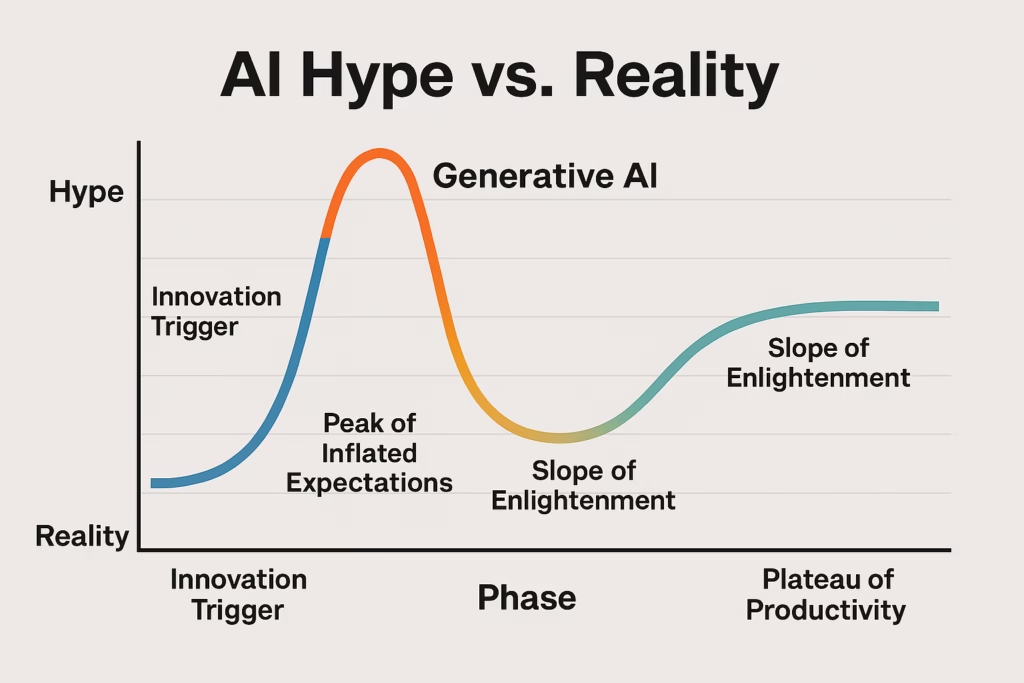
The report delves into the disparity between public perception and the actual state of AI capabilities. Referencing the Gartner Hype Cycle, a model that illustrates the maturity, adoption, and social application of technologies, it notes that as of November 2024, Generative AI had surpassed its peak hype and was on the downswing. This indicates a transition from inflated expectations to a more tempered understanding of the technology’s capabilities and limitations.
Survey Findings on AI Perception
Survey results revealed that 79% of respondents believe current public perceptions of AI’s capabilities do not align with the realities of AI research and development. Furthermore, 90% indicated that this mismatch hinders research progress, with 74% attributing the misdirection of AI research efforts to the prevailing hype. These findings highlight the need for clearer communication and education to bridge the gap between public expectations and scientific realities.
Challenges in Achieving AGI
Limitations of Current Approaches
A significant portion of the AI research community expresses skepticism regarding the sufficiency of scaling existing AI methodologies to achieve AGI. Specifically, 76% of surveyed researchers believe that merely expanding current approaches will not lead to the development of human-level intelligence in machines. This sentiment suggests that novel paradigms and innovative strategies are necessary to make meaningful progress toward AGI.
Community Insights on AGI Development
The report emphasizes a cautious yet forward-moving approach among AI researchers. Priorities include safety, ethical governance, equitable benefit-sharing, and gradual innovation. The community advocates for collaborative and responsible development practices over a competitive “race” toward AGI, recognizing the profound implications such advancements could have on society.
Progress and Innovations in AI
Advances in AI Capabilities
Despite the challenges associated with achieving AGI, the field of AI has experienced significant advancements. Five years ago, AI applications were largely confined to areas where errors were tolerable or domains were strictly circumscribed. Today, AI systems have expanded into more complex and general applications, demonstrating remarkable progress in various tasks.
The Role of Large Language Models
Large Language Models (LLMs) like ChatGPT have brought AI into the public spotlight, showcasing the potential of AI to engage in coherent and contextually relevant conversations. However, challenges remain, particularly concerning the factual accuracy of AI-generated responses. Benchmark tests conducted in 2024 revealed that leading LLMs correctly answered only about half of the questions posed. Innovative training methods and organizational strategies are being explored to enhance the robustness and reliability of these models. To explore how AI is impacting industries beyond research, check out this article on Trenzest.com.
The Path Forward: Recommendations and Strategies
Emphasizing Safety and Ethical Governance
The report underscores the importance of integrating safety and ethical considerations into AI research and development. Establishing frameworks that ensure AI systems are trustworthy, fair, and aligned with human values is paramount. This approach aims to mitigate risks and maximize the beneficial impact of AI technologies.
Encouraging Collaborative and Responsible Development
Rather than engaging in a competitive rush toward AGI, the report advocates for a collaborative approach that prioritizes responsible innovation. This includes fostering partnerships across academia, industry, and government to share knowledge, resources, and best practices. Such collaboration can facilitate the development of AI systems that are not only advanced but also aligned with societal needs and ethical standards.
Conclusion
The pursuit of Artificial General Intelligence represents one of the most ambitious endeavors in the field of artificial intelligence. The AAAI’s 2025 Presidential Panel report serves as a critical reflection on our current path, highlighting the need for strategic reassessment and the adoption of methodologies that prioritize safety, ethics, and collaborative progress. While AGI remains a long-term goal, the insights provided by AI experts underscore the importance of measured, responsible development. As AI continues to evolve, the future will be shaped by our ability to balance innovation with caution, ensuring that advancements benefit society as a whole.
For more expert insights into AI advancements and business applications, visit Trenzest.com.