Introduction: Tattoos Beyond Art
Tattoos have long been a symbol of identity, self-expression, and culture. But what if tattoos could do more than speak your story—what if they could read your mind?
Researchers at the University of Texas at Austin are pioneering a futuristic innovation: an ultra-thin, brain-monitoring “e-tattoo” that may one day help measure cognitive load in real time. This breakthrough in wearable technology blends science fiction with reality and signals a massive leap forward in how we interact with our own bodies and minds.
The Rise of Electronic Tattoos
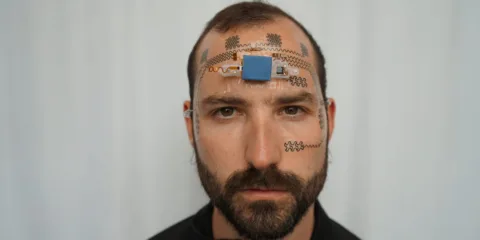
Dr. Nanshu Lu, professor in the Department of Aerospace Engineering and Engineering Mechanics, along with fellow professor Luis Sentis, has developed a wireless, skin-conforming device that resembles a temporary tattoo sticker. Unlike traditional tattoos, this e-tattoo is non-invasive, adhesive-based, and capable of tracking brain waves and eye movement.
Their primary goal? To monitor mental workload in individuals performing cognitively demanding tasks.
How the Brain-Reading Tattoo Works
This electronic tattoo uses a Bluetooth chip and a lightweight microprocessor to analyze neurological signals and track eye movement. In trials, participants performed memory-based tasks on a screen while the tattoo collected and transmitted real-time brain data.
The device is a streamlined alternative to traditional EEG (electroencephalogram) setups that require full-scalp electrodes and conductive gels. Instead, this new model works from the forehead only, making the entire process less intrusive and far more user-friendly.

Nanshu Lu/University of Texas at Austin
Why This Matters: Mental Workload and High-Stakes Jobs
Jobs such as piloting aircraft, directing air traffic, operating drones, or telemanaging robots demand high levels of attention and come with little margin for error. Overloading these professionals could not only compromise mission outcomes but also lead to serious health consequences.
“Technology is developing much faster than human evolution,” Lu told Business Insider. “It’s very important not to overload the operator.”
The e-tattoo provides an objective, real-time method for assessing and managing this workload—something that could revolutionize performance and safety in critical industries.
The Evolution of Human-Tech Integration
Human and machine convergence isn’t new. From pacemakers to prosthetics, and now brain-computer interfaces, technology continues to redefine human limitations.
Remember the digital hearing aid’s debut in the 1980s? Fast forward to Neuralink—a company founded by Elon Musk—embedding chips directly into the human brain. The trajectory is clear: the human body is becoming an interface.
Wearables Then and Now
Modern consumers already use wearables like smartwatches, VR headsets, and the Oura Ring to monitor physical health, sleep, and activity levels. However, few devices today venture into the territory of brain function.
That’s where the e-tattoo stands out. It goes beyond lifestyle tracking to tap directly into neurological activity.
And the market is growing fast. According to Grand View Research, the global wearable tech market, valued at $84.2 billion in 2024, is expected to reach a staggering $186.14 billion by 2030.
The Future of EEG Monitoring
While still in development, this tech opens doors to real-time brainwave tracking using machine learning embedded directly within the device. The goal? Autonomous performance feedback without the need for post-task questionnaires.
Imagine real-time notifications that signal when your brain is fatigued or hyper-focused—perfect for enhancing productivity, reducing burnout, and even supporting meditation practices.
The Business Potential of Brain-Tech
Startups and tech companies in healthtech, productivity, and AI-driven analytics will find fertile ground here. Brainwave analytics could inform product design, workplace ergonomics, or even digital marketing strategies.
This aligns with broader trends in neurotechnology—a field that’s fast becoming essential for businesses aiming to optimize human performance.
What This Means for Innovators and Entrepreneurs
If you’re building a business at the intersection of technology and human behavior, now is the time to pay attention. Brain-computer interfaces and wearables aren’t just gimmicks—they’re the next leap in user experience and data personalization.
At Trenzest, we spotlight such forward-looking innovations to help entrepreneurs, marketers, and tech enthusiasts stay ahead of the curve. Whether you’re launching a wellness product or developing AI tools, understanding these shifts gives you a serious competitive edge.
Conclusion: A Mindful Future
Though commercial availability is still years away, the potential applications of e-tattoos are vast—from improving focus and stress management to enhancing safety in high-risk professions.
As the line between human biology and technology continues to blur, staying informed and adaptable will be key to thriving in tomorrow’s economy.
Let Trenzest be your go-to platform for decoding the future of technology and turning insight into impact.