
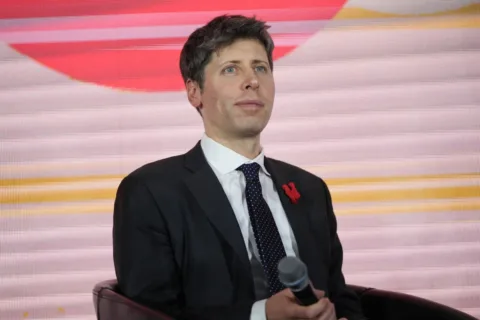
In The Optimist: Sam Altman, OpenAI, and the Race to Invent the Future, Wall Street Journal reporter Keach Hagey delivers a compelling exploration of our AI-obsessed era through the lens of one of its most influential figures — Sam Altman, co-founder and CEO of OpenAI.
Hagey traces Altman’s journey from his Midwest upbringing to his early days at the location-sharing startup Loopt, through his influential stint at Y Combinator, and finally to his current role shaping the future of artificial intelligence at OpenAI. Her book also reveals new insights into the high-stakes drama that unfolded when Altman was abruptly fired and quickly reinstated as OpenAI’s CEO — a moment internally dubbed “the Blip.”
The Blip: A Crisis of Governance
Hagey describes the brief ousting of Altman as a clear signal of OpenAI’s internal instability. The organization’s unique structure — a for-profit company governed by a nonprofit board — was, in her words, “not stable.” While there had been plans for the for-profit entity to assume more control, those have since been walked back. The result? Ongoing uncertainty and investor hesitancy.
When asked if this could hinder OpenAI’s ability to raise critical funding, Hagey didn’t mince words: “Absolutely.” While she believes Altman may be up to the task, she adds, “Success is not guaranteed.”
Altman: Deal Maker, Idealist, Salesman
The biography, also available as an audiobook on Spotify, dives deep into Altman’s political leanings, describing them as “traditionally progressive.” Still, he’s managed to strike major infrastructure deals under the Trump administration — an unusual feat for someone with his background.
“Sam is a deal maker, and Trump is a deal maker,” Hagey said. “Trump respects nothing so much as a big deal with a big price tag, and that’s what Sam is really great at.”
In a conversation with TechCrunch, Hagey unpacked more of her process, including Altman’s initial skepticism about the book. She explained that while Altman believes we focus too much on individuals rather than institutions — and that it’s too early to judge OpenAI’s impact — she disagrees.
“OpenAI has already reshaped the stock market and transformed the narrative in the business world. As a business journalist, I can tell you — we talk about AI every single day.”
The Biography That Almost Wasn’t
Altman didn’t welcome the book at first. Hagey initially planned to write what’s called a “write-around” — a biography built without the subject’s cooperation. But as her research progressed and she spoke to dozens of sources, Altman eventually agreed to multiple in-depth interviews.
Still, he chose not to read the finished book. “He tweeted about it and was clear that he wouldn’t read it,” Hagey said. “Much like how I don’t listen to my own podcast appearances.”
A Valley Archetype — With a Twist
So what makes Altman such a quintessential Silicon Valley figure? According to Hagey, it’s partly his youth — launching his first startup at just 19 — and his extraordinary fundraising talent.
“He’s a master storyteller,” Hagey explained. “He can walk into a room and convince people he sees the future. But that’s a double-edged sword — some feel what he says doesn’t always match reality.”
This blend of visionary leadership and selective transparency has caused trust issues in the past — at Loopt, Y Combinator, and OpenAI itself. Hagey reveals that Altman tends to avoid conflict and often tells people what they want to hear, which can lead to managerial instability.
What the Firing Revealed About Power
Hagey argues that Altman’s brief removal exposed the core issue with OpenAI’s governance: major stakeholders like Microsoft have no formal control, yet wield immense informal influence. When OpenAI employees threatened to defect en masse to Microsoft, the board had little choice but to reinstate Altman.
This, she suggests, is the real lesson from “the Blip”: legal structures matter less than actual power dynamics.
The Funding Challenge Ahead
OpenAI has since walked back from plans to become a fully investor-controlled for-profit company. Although the new structure — a public benefit corporation — is slightly more investor-friendly, it remains governed by a nonprofit board. Hagey believes this hybrid model could continue to create friction.
Given how capital-intensive OpenAI’s work is, fundraising will remain critical. And without more investor influence, some may hesitate to contribute.
AI and the Moral Project
One of the book’s deeper themes is that AI is not just a technical or commercial enterprise — it’s a moral one. That’s why Altman’s personal philosophy, ethics, and upbringing matter.
Hagey delves into Altman’s family background, especially the influence of his father, Jerry Altman, a public-policy-driven idealist who helped shape housing finance reform. His mother, a dermatologist and working mom of four, embodied ambition and resilience.
Growing up as a gay teenager in the Midwest, Sam developed a mix of idealism and tenacity. He became a confident public speaker and later, a prominent advocate for social progress. His wedding — unimaginable in his youth — symbolized how much the world has changed, reinforcing his faith in the power of progress.
Navigating AI’s Conflicting Futures
Writing about AI, Hagey found herself navigating two opposing narratives: the utopian “boomers” who believe AI will solve everything, and the “doomers” warning it could end humanity.
But to her, both sides feed into the same larger belief: AI is an epoch-defining force. The more mundane possibility — that AI might simply become another tool like email or spreadsheets — rarely gets discussed.
“The doomers and boomers are part of the same hype universe,” she said.
So Where Does She Stand?
While Hagey doesn’t take a firm stance, she admits her view has evolved.
“I was more skeptical in the beginning. But as the tools improved — and as I started using them more myself — I became less so.”
Final Thoughts: Sam Altman’s Future Is AI’s Future
Through meticulous reporting and candid interviews, The Optimist reveals not just the story of a man, but a window into how power, ambition, and idealism are shaping the future of artificial intelligence.
Whether Sam Altman ultimately succeeds in his mission remains uncertain. But one thing is clear: the stakes couldn’t be higher.
For more digital growth insights, visit Trenzest.com and subscribe to our newsletter to stay informed.