Introduction: A New Quantum Frontier
Quantum physics is a field known for its surprises. As researchers continue to push the boundaries of our understanding, new ideas emerge—some solid, others speculative. Among these, paraparticles represent a theoretical class of particles that sit outside the traditional binary of bosons and fermions, offering a middle ground and potentially unlocking new states of matter.
What Are Paraparticles?
In traditional quantum theory, particles are classified as either bosons or fermions, each governed by unique rules of behavior. Bosons can share quantum states freely, while fermions adhere to the Pauli exclusion principle—only one particle per state.
Paraparticles are theoretical constructs that allow a few particles to occupy the same quantum state, but not infinitely. This introduces a more complex statistical behavior, expanding the potential for modeling exotic phases of matter in quantum systems.
The Swap Game: Unseen Interactions
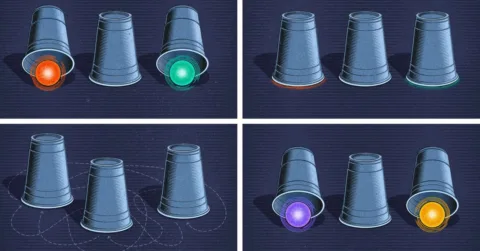
Imagine two paraparticles—one “internally red” and the other “internally blue.” When they swap places, instead of keeping their internal colors, they transform into new colors, like “green” and “yellow.” This metaphor highlights the intricacy of paraparticle behavior, where the particles influence one another invisibly during motion.
This interaction creates a dynamic and unpredictable system governed by mathematical symmetry models, making paraparticles particularly fascinating to theoretical physicists and quantum modelers.
Rethinking the Foundations: Müller’s Perspective
While researchers like Wang and Hazzard proposed models allowing paraparticles, German physicist Markus Müller approached the problem from a different angle. Revisiting the Doplicher-Haag-Roberts (DHR) theorems, which underpin much of quantum field theory, Müller’s team aimed to impose stricter conditions on what it means for particles to be truly indistinguishable.
Their work operates in a dense mathematical landscape but focuses on a practical question: If two particles are truly identical, should it matter if they’re swapped in only one part of a quantum superposition?
Indistinguishability in Quantum Superpositions
Müller and his team introduced a stricter notion of indistinguishability. In quantum superpositions—where systems exist in multiple states at once—an observer may switch perspectives between different branches of reality. If particles are indistinguishable, swapping them in one branch but not the other should have no measurable impact.
However, under this assumption, paraparticles become impossible. Their presence would allow different branches of the superposition to produce different results—violating the very principle of indistinguishability that underpins particle physics.
Paraparticles vs. Bosons and Fermions
In Müller’s view, only bosons and fermions meet the criteria for true indistinguishability. Paraparticles, as defined in the opposing framework, are distinguishable when two observers compare their measurements—an idea that directly challenges the foundational postulates of quantum theory.
Still, the model by Wang and Hazzard doesn’t violate any known laws—it simply starts with different assumptions. It allows paraparticles to exist in scenarios where observer comparison reveals that a swap has occurred, enabling differentiation between particles.
This opens the door to new statistical behavior—neither entirely bosonic nor fermionic.
Theoretical Implications and Potential
If validated, paraparticles could revolutionize our understanding of quantum matter. They may help model intermediate behaviors in systems that are not accurately described by bosons or fermions alone.
This new framework provides flexibility for modeling quantum systems with a wide range of potential behaviors. According to Meng Cheng, a Yale physicist, paraparticles could make previously unsolvable models of exotic quantum phases more accessible and understandable.
Experimental Outlook: Rydberg Atoms and Beyond
Although paraparticles remain theoretical, experimentation is catching up. Bryce Gadway, an experimental physicist at Penn State, is optimistic. He suggests that Rydberg atoms, which are highly excited atoms with loosely bound electrons, are ideal for creating paraparticles.
Rydberg atoms are sensitive to electric fields and are often used in quantum simulators and quantum computing. These systems naturally evolve in ways that may lead to paraparticle creation.
As Gadway put it, “You just prepare them and watch them evolve.”
The Future of Paraparticles in Quantum Research
Despite the excitement, many physicists—including Nobel laureate Frank Wilczek—remain cautiously skeptical. Wilczek notes that paraparticles are still a “theoretical curiosity” until verified in experimental settings.
However, their potential cannot be ignored. The idea that we may discover a third kingdom of particles is both thrilling and disruptive. It hints at emergent phenomena in quantum materials and challenges long-standing assumptions in physics.
Final Thoughts: A Balanced View on Emerging Matter
Paraparticles may not replace bosons or fermions, but they offer a new perspective that could reshape certain areas of condensed matter physics, quantum computing, and statistical mechanics. Whether or not they are eventually confirmed in laboratories, they provide fertile ground for academic inquiry.
As quantum theory evolves, so too will our tools and classifications. And paraparticles, even if temporary intellectual stepping stones, may help bridge our understanding of more complex quantum systems.
For more digital growth insights, visit Trenzest.com and subscribe to our newsletter to stay informed.