
Introduction
Artificial Intelligence (AI) tools are reshaping how individuals and organizations work, create, and innovate. Recently, OpenAI and Anthropic released studies highlighting how their flagship models—ChatGPT and Claude—are being used in real-world scenarios. While both tools offer powerful capabilities, their usage patterns reveal distinct roles: ChatGPT leans toward augmentation, while Claude increasingly supports automation.
Key Insights from OpenAI’s Study
Writing, Editing, and Summarization
OpenAI found that ChatGPT excels in writing, editing, summarization, and brainstorming. Students rely on it for essay drafts, marketers for campaign ideas, and knowledge workers for refining reports. Educators use ChatGPT to design quizzes, tutor students, and simplify complex topics.
“Doing,” “Asking,” and “Expressing” Conversations
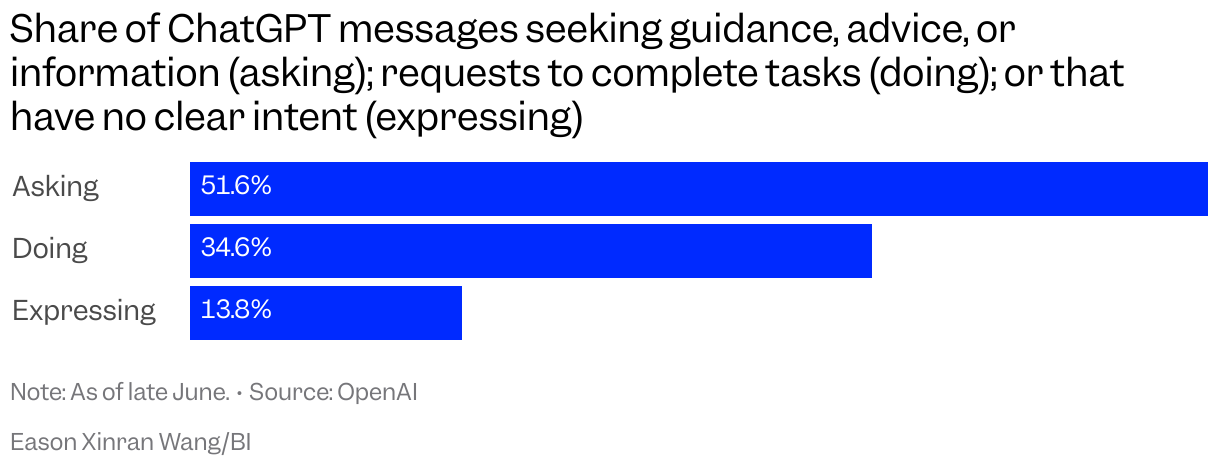
The study categorized conversations into three types:
Doing: producing outputs ready for use in workflows.
Asking: supporting decision-making without direct output.
Expressing: creative or exploratory conversations.
As of June, “Asking” interactions dominated ChatGPT usage, underscoring its value in supporting decisions and idea generation.
Anthropic’s Findings on Claude
Coding and Automation Use Cases
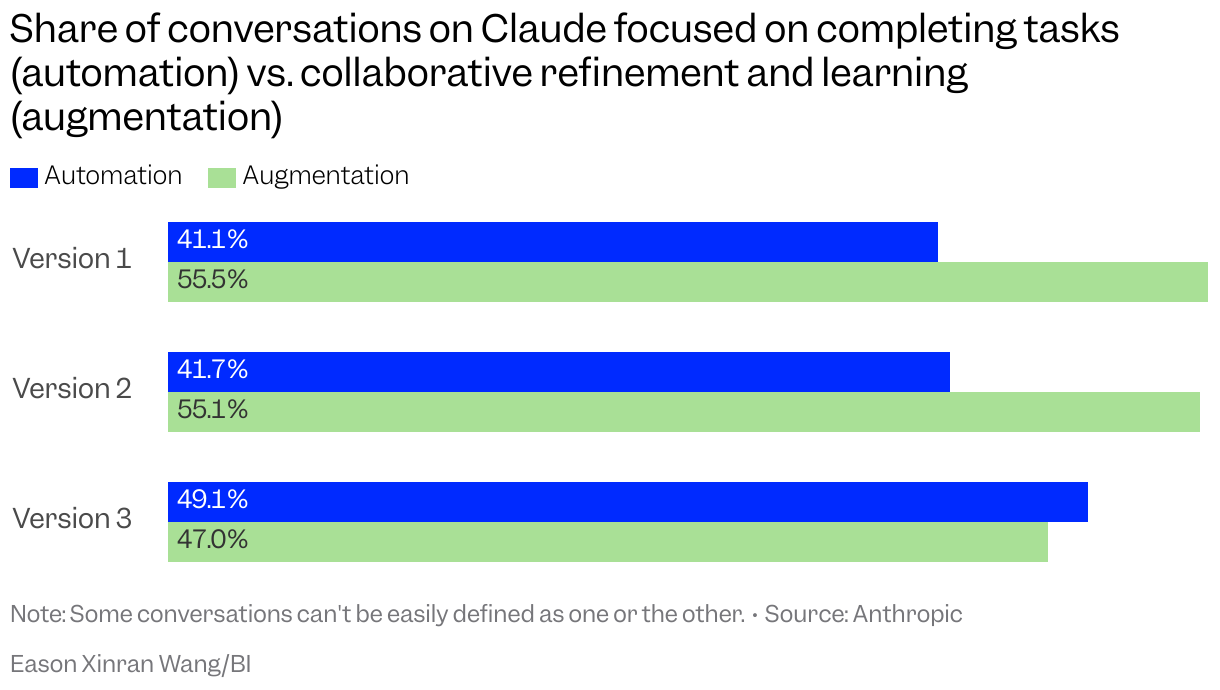
Anthropic’s research reveals that Claude is heavily used for coding, mathematics, and automation tasks—with coding-related usage alone accounting for more than one-third of interactions.
Enterprise-Scale Efficiency
Claude is often embedded into enterprise workflows for document processing, bulk report generation, and automated software development. Notably, this latest study marks the first time automation surpassed augmentation in Claude’s usage trends.
Comparing Augmentation vs. Automation
The contrast is clear:
ChatGPT thrives in consumer productivity, enabling users to collaborate and iterate with the AI.
Claude supports large-scale automation, handling structured tasks and streamlining enterprise operations.
Future workplaces may leverage both: ChatGPT for communication and creativity, and Claude for efficiency-driven execution.
What This Means for Businesses and Marketers
For entrepreneurs, marketers, and decision-makers, these studies highlight a practical takeaway: AI is not one-size-fits-all. Businesses can combine augmentation and automation to maximize impact—balancing creativity with efficiency.
How Trenzest Fits Into the Conversation
At Trenzest, we help businesses navigate emerging AI trends and integrate tools like ChatGPT and Claude into their strategies. Whether you’re exploring automation for enterprise workflows or leveraging augmentation for content creation, Trenzest provides tailored insights and strategies that align with your goals.
For more AI-driven insights and marketing strategies, explore our latest resources.
Final Thoughts and Next Steps
AI adoption is accelerating, and understanding how users engage with ChatGPT vs. Claude is critical for shaping future strategies. ChatGPT shines in collaborative creativity, while Claude is gaining traction in automation-heavy use cases.
With Trenzest, you gain a partner who can help you stay ahead of these shifts and unlock the full potential of AI for your business. Contact us to learn more.